
How does laser eye surgery work?
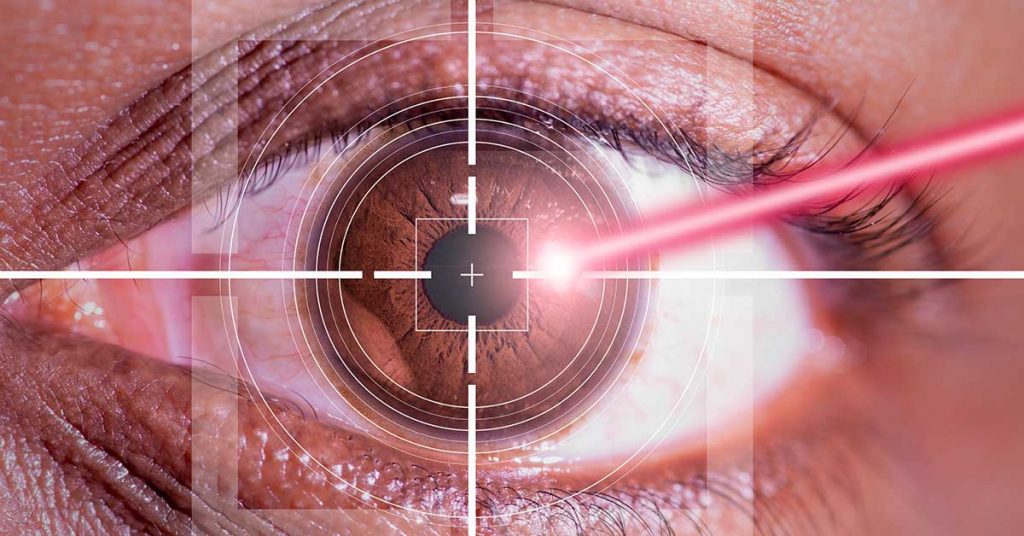
The cornea provides a large part of the eye’s focusing power. The laser changes its curvature precisely: in myopia its power is reduced, in hyperopia it is increased and astigmatism is evened out. The laser itself works for only a few seconds; including everything in the laser room, the procedure takes about 7–20 minutes for both eyes, depending on the method.
Laser methods at a glance
| Method | How it works | Recovery |
|---|---|---|
| PRK / No-Touch (TransPRK) | Surface treatment; with No-Touch the eye is not touched by any instrument | Grittiness and watering for 2–3 days; best vision after about 10 days to 2 months |
| LASIK / Femto-LASIK | A thin corneal flap is created (with a femtosecond laser in Femto-LASIK) and the cornea is reshaped beneath it | Mild burning for 3–4 hours; vision usually good the next day |
| SMILE | A small lens-shaped piece of tissue is removed through a tiny opening, without a flap | Fast recovery; reaching the best vision sometimes takes 1 week to 10 days |
Surface methods are mainly preferred for thinner corneas; LASIK/Femto-LASIK and SMILE are suited to corneas of good thickness and recover faster.
Who is suitable?
- aged 18 or over
- a glasses prescription that has been stable for at least one year
- suitable corneal thickness and topography
- no dry eye, or dry eye that is under control
- no retinal problem that rules out laser treatment
- not pregnant or breastfeeding
- realistic expectations
Laser treatment is generally not suitable in uncontrolled diabetes or rheumatic disease, advanced keratoconus, advanced glaucoma or cataract. If laser is not an option, other solutions such as implantable lenses (ICL) may be considered.
The examination before laser surgery
- corneal topography and tomography (shape and stability of the cornea)
- corneal thickness
- prescription and visual acuity
- dry eye assessment
- pupil size and night vision
- retinal examination (especially important in myopia)
- eye pressure and general eye health
Contact lenses must be removed beforehand for accurate measurements: soft lenses at least 1 week, rigid lenses at least 3 weeks.
Is laser eye surgery painful?
No. The eyes are numbed with drops. You may occasionally feel the touch of the surgeon or the device, but no pain.
After the operation
- Do not rub your eyes — this is particularly important after LASIK.
- Use your eye drops regularly.
- Avoid dusty environments, swimming pools and Turkish baths for a while because of the risk of infection.
- Do not skip your check-ups.
Risks and long-term results
The most frequently discussed risks are dry eye, glare or halos around lights at night (especially with certain pupil characteristics) and a small residual prescription or regression. Rare complications are assessed individually at the examination.
In most myopic patients the result remains stable over the long term; regression is more common after the treatment of hyperopia. Eyes can change at any age, so lifelong stability cannot be guaranteed. From around 45, reading glasses become necessary for most people regardless of laser treatment — laser is still possible after 40, and this is discussed individually.